
Lotus by Zaha Hadid Architects

published in: Architecture By PR, Sep 11th 2008

‘Lotus’ Zaha Hadid Architects
Design: Zaha Hadid and Patrik Schumacher
Design Team: Melodie Leung and Gerhild Orthacker
On view 10 Sept – 23 November at the 11th Venice Architecture Biennale

Project description:
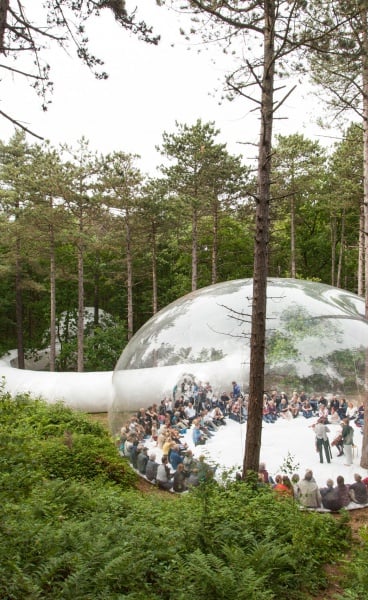
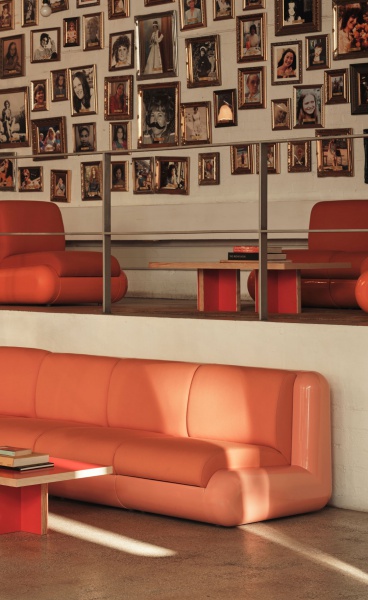
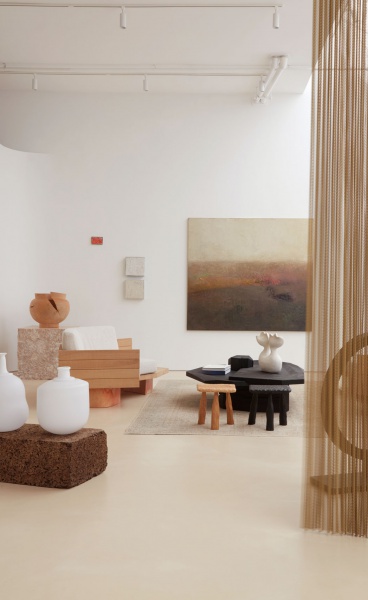
The ‘Lotus’ room is conceived as a fragmented enclosure that can be compressed and expanded into programmed areas for resting, sitting, storage, and browsing. A multitude of folds structure these programs both formally and functionally. The space of the room is in transience and fluctuates between two extreme states: one which is highly condensed and exclusive of its surroundings and the other which is unfolded, dispersed and interlocked into its environment. Furniture and Architecture become integrated and mobile as the various parts are released from their compact configuration to reveal a mobile desk with encased chair, bed, shelving, a wardrobe rail/room divider, and end table. Increased variety and possibilities for habitation are revealed as the Lotus seductively sheds and unveils its embedded counterparts.

 

don't miss  Andrea Palladio and Contemporary Architects, Villa Foscari La Malcontenta
sources:

Zaha Hadid

Related Articles
Hadid Zaha

About Zaha Hadid

photo © Gautier Deblonde

Zaha Hadid, founding partner of Zaha Hadid Architects, was awarded the Pritzker Architecture Prize in 2004 and is internationally known for her built, theoretical and academic work. Each of her dynamic and innovative projects builds on over thirty years of revolutionary experimentation and research in the interrelated fields of urbanism, architecture and design.
Working with senior office partner Patrik Schumacher, Hadid’s interest is in the rigorous interface between architecture, landscape, and geology as the practice integrates natural topography and human-made systems that lead to experimentation with cutting-edge technologies. Such a process often results in unexpected and dynamic architectural forms.
The MAXXI: National Museum of 21st Century Art in Rome, BMW Central Building in Leipzig and Phaeno Science Center in Wolfsburg are excellent demonstrations of the practice’s quest for complex, dynamic space. Previous seminal buildings, such as the Rosenthal Center for Contemporary Art in Cincinnati and Hoenheim-Nord Terminus in Strasbourg have also been hailed as architecture that transforms our vision of the future with new spatial concepts and bold, visionary forms.
Currently, the practice is working on a multitude of projects including; the Fiera di Milano master-plan and tower, the Aquatics Centre for the London 2012 Olympic Games, High-Speed Train Stations in Naples and Durango, the CMA CGM Head Office tower in Marseille and urban master-plans in Beijing, Bilbao, Istanbul, Singapore and the Middle East.
Zaha Hadid Architects continues to be a global leader in pioneering research and design investigation. Collaborations with artists, designers, engineers and clients that lead their industries have advanced the practice’s diversity and knowledge, whilst the implementation of state-of-the-art technologies have aided the realization of fluid, dynamic and therefore complex architectural structures.
Zaha Hadid’s work was the subject of a critically-acclaimed retrospective exhibition at New York’s Solomon R. Guggenheim Museum in 2006 and showcased at London’s Design Museum in 2007. Hadid’s recently completed projects include the Nordpark Railway stations in Innsbruck, Mobile Art for Chanel in Hong Kong, Tokyo and New York, the Zaragoza Bridge Pavilion in Spain and the Burnham Pavilion in Chicago.

[official website]

Your message is awaiting moderation. Thank you.

Leave a comment

Make sure you enter the * required information where indicated. Please also rate the article as it will help us decide future content and posts. Comments are moderated. Please no link dropping, no keywords or domains as names; do not spam, and do not advertise!